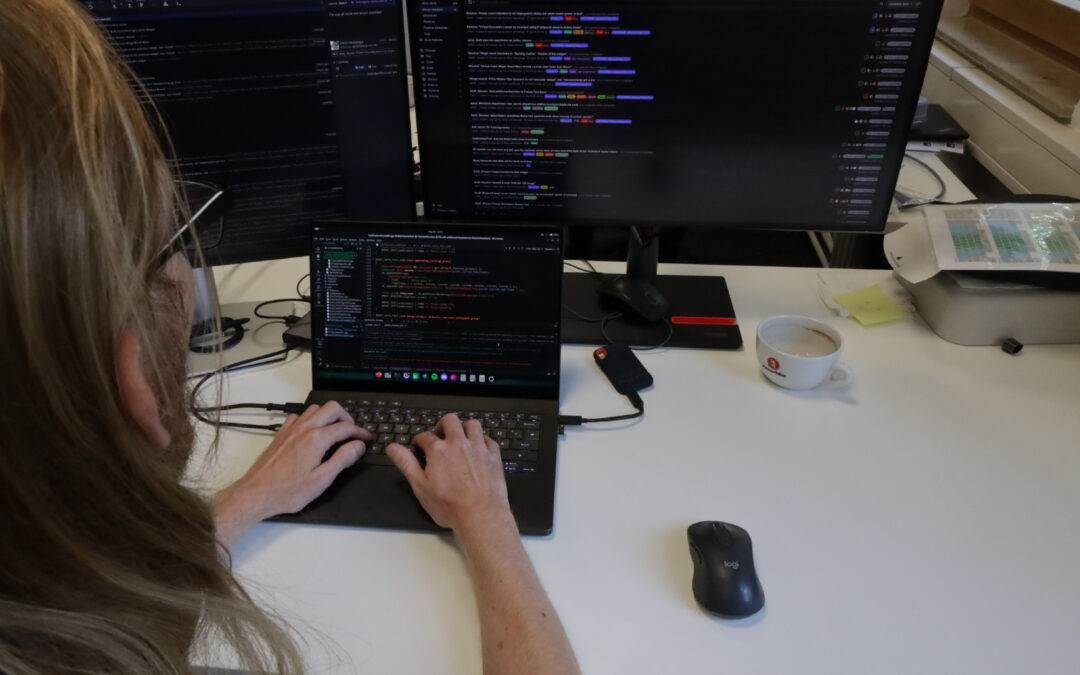
Not every PCB requires the same assembly process. Component types, board complexity, production quantities, and design maturity all influence whether automated assembly, manual assembly, or a combination of both is the most suitable approach.
Automated assembly offers speed and repeatability, while manual processes provide flexibility for prototypes, specialized components, and adjustments during development. In practice, both methods often work together, particularly when a board combines surface-mount (SMT) and through-hole (THT) components.
At Bretgeld Engineering, we use both automated and manual assembly processes to accommodate different production requirements, from early prototypes to series production.
Manual and Automated PCB Assembly Defined
The main difference between manual and automated PCB assembly lies in how components are placed and soldered onto the board.
Manual PCB Assembly
Manual assembly involves technicians placing and soldering components using hand tools. It allows individual components to be handled, adjusted, or replaced directly, making it useful for prototypes and components requiring manual intervention.
Automated PCB Assembly
Automated assembly uses programmed equipment for component placement and soldering. In SMT production, machines apply solder paste, position components, and prepare boards for a controlled soldering process. Inspection equipment helps identify defects during production.
Manual PCB Assembly: Process, Strengths, and Limitations
Manual Assembly Workflow
Depending on the board design and components, the process may include:
- Production data review: Check assembly drawings, the Bill of Materials (BOM), and relevant manufacturing instructions.
- Component placement: Position surface-mount (SMD) and through-hole (THT) components using appropriate hand tools.
- Soldering: Solder components manually or use dedicated vapor phase soldering equipment for suitable SMT assemblies.
- Inspection and rework: Inspect assembled components and solder joints, making corrections where necessary.
- Functional testing: Verify board functionality, using dedicated test equipment when required.
Strengths of Manual Assembly
- Flexibility during development: Component changes and design adjustments can be incorporated without reprogramming an automated assembly line.
- Suitable for small quantities: Manual assembly avoids some of the setup effort associated with automated production, making it practical for prototypes and small batches.
- Handling of specialized components: Components that cannot be placed or soldered using standard automated processes can be assembled individually.
- Support for prototyping: Individual boards can be assembled, inspected, and modified as part of the development and validation process.
At Bretgeld Engineering, fully manual assembly is generally used for prototypes and quantities of up to approximately 20 boards.
Limitations of Manual Assembly
- Assembly time: Depending on board complexity and component count, manual assembly may take approximately 1–5 hours per board.
- Limited scalability: Assembly time and labor requirements increase with production volume, making fully manual assembly less practical for larger quantities.
- Process repeatability: Manual placement and soldering depend on technician skill and require appropriate inspection to maintain consistent results.
- Production documentation: Manual operations may require additional recording steps to maintain traceability.
Automated PCB Assembly: Process, Strengths, and Considerations
Automated Assembly Process
At Bretgeld Engineering, the automated SMT assembly process includes:
- Solder paste application and inspection: Solder paste is applied to the PCB using a stencil printer. Solder Paste Inspection (SPI) checks the deposits before component placement.
- Pick-and-place: Automated machines position surface-mount components (SMDs) on the board, with a reported placement capacity of up to 30,000 components per hour.
- Vapor phase soldering: The assembled boards undergo a controlled soldering process using vapor phase technology.
- Automated optical inspection (AOI): The assembled boards are inspected for component placement and visible soldering defects.
- Functional testing and programming: Boards undergo functional checks, including firmware programming and testing of relevant functions and connections, according to project requirements.
Benefits of Automated Assembly
- Production speed: Automated component placement allows larger quantities of boards to be assembled more efficiently than fully manual processes.
- Consistency and repeatability: Programmed placement and controlled soldering processes help maintain consistent assembly conditions across production runs.
- Process inspection: SPI and AOI provide inspection points during production, helping identify defects before boards proceed to subsequent stages.
- Efficiency across production runs: Once the production process is configured, the setup effort can be distributed across multiple boards, reducing the relative cost of assembly as quantities increase.
Setup and Production Considerations
- Initial preparation: Automated assembly requires machine programming, production data preparation, and equipment setup before manufacturing begins.
- Design readiness: Accurate component footprints, placement data, and a complete Bill of Materials (BOM) are important for preparing the automated process.
- Design changes: Modifications to components or PCB layouts may require adjustments to machine programs and production settings.
- Component requirements: Some components or assembly operations may still require manual intervention, even when most of the board is assembled automatically.
When Manual and Automated Assembly Work Together
Not every board can—or needs to—be assembled using a single process.
A PCB may contain standard surface-mount components alongside through-hole connectors or specialized components that require manual handling. In these cases, automated SMT assembly can be combined with manual placement and soldering operations.
This is not limited to prototypes. At Bretgeld Engineering, combined assembly processes can also be used for production runs of several hundred boards, depending on their component requirements.
The result is a production process in which automated equipment handles repeatable operations while manual assembly is used where it adds practical value.
Choosing an Assembly Method
Manual and automated PCB assembly serve different production requirements, and neither is necessarily the better choice for every project. The most suitable approach depends on component types, production quantities, design maturity, and the operations required to assemble and test the board.
IRelated reading: [Choosing a PCB Assembly Process: From Prototypes to Series Production]
Learn more about PCB Assembly at Bretgeld Engineering.